


Industry News
494 operators worldwide have launched FWA services
Views : 685
Author : JIUZHOU
Update time : 2024-11-22 09:09:56
The Mobile Suppliers Association has provided data on Fixed Wireless Access broadband services. A total of 564 operators from 188 countries and regions have announced such services.
Among them, 494 operators in 176 countries and regions have launched services. Compared with the survey data from May this year, the number of operators announcing services has increased by 97. Meanwhile, the number of operators proposing services has grown by 87.
Recently, the Mobile Suppliers Association updated the report on the status of the Fixed Wireless Access, FWA market. This also provides the latest information on the availability of FWA broadband services based on LTE and 5G. The Mobile Suppliers Association said the study was conducted in October 2024.
As technology advances, operators have turned to mobile networks to provide residential and business broadband services.
Some companies also offer mobile-based broadband services as an alternative to fixed-line broadband technology.
Wireless residential and business broadband services no longer rely solely on old technology. Now, these services use mobile technology to provide primary broadband connections for homes and businesses.
Known as FWA, this service is delivered through a mains-powered CPE. The CPE provides local network connectivity to other devices, usually via Wi-Fi. In a relatively short period of time, FWA broadband has become a mainstream service.
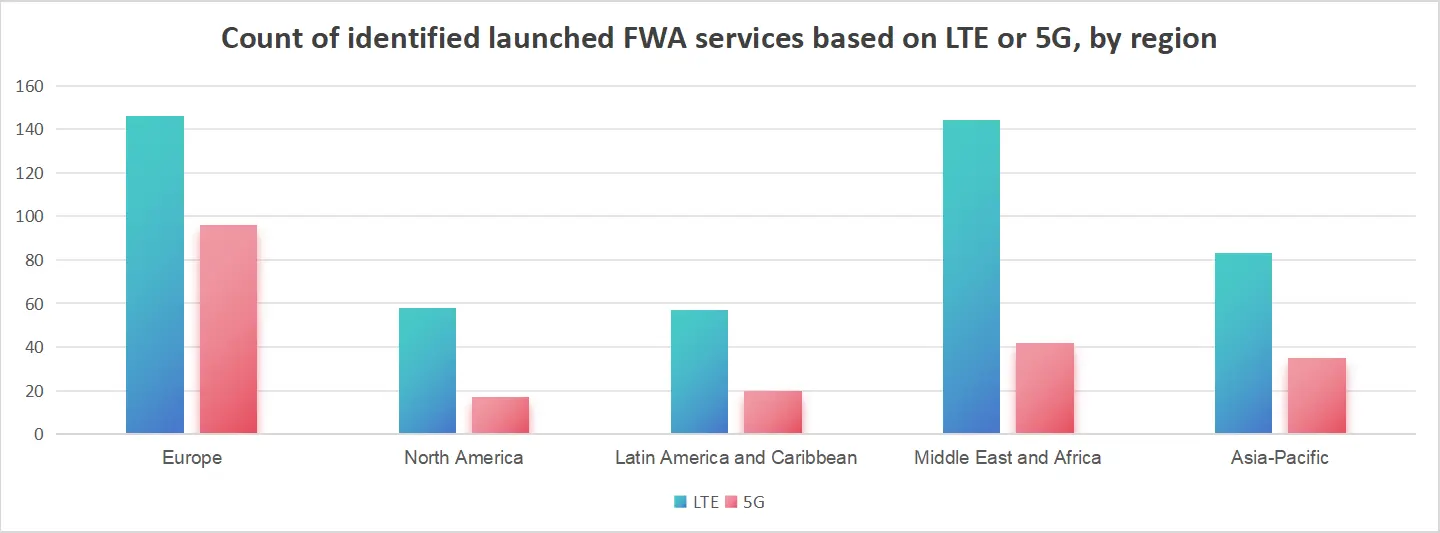
The EMEA region has the most operators offering FWA services with LTE or 5G. There are 242 operators in Europe and 186 in the Middle East and Africa. Next are 118 operators in Asia-Pacific, 77 in Latin America and the Caribbean, and 75 in North America.
Over 50% of LTE fixed wireless access plans are data-based. Compared to just over 21% using a speed-based pricing model, with a smaller gap observed in 5G FWA.
Based on data from 334 operators in October 2024:
The average advertised maximum peak download speed for LTE FWA is 157.2 Mbps, down from 178.6 Mbps in June 2024. For 5G-based services, maximum peak download speeds averaged 790.7 Mbps, down from 974 Mbps in June 2024.
Among them, 494 operators in 176 countries and regions have launched services. Compared with the survey data from May this year, the number of operators announcing services has increased by 97. Meanwhile, the number of operators proposing services has grown by 87.
Recently, the Mobile Suppliers Association updated the report on the status of the Fixed Wireless Access, FWA market. This also provides the latest information on the availability of FWA broadband services based on LTE and 5G. The Mobile Suppliers Association said the study was conducted in October 2024.
As technology advances, operators have turned to mobile networks to provide residential and business broadband services.
Some companies also offer mobile-based broadband services as an alternative to fixed-line broadband technology.
Wireless residential and business broadband services no longer rely solely on old technology. Now, these services use mobile technology to provide primary broadband connections for homes and businesses.
Known as FWA, this service is delivered through a mains-powered CPE. The CPE provides local network connectivity to other devices, usually via Wi-Fi. In a relatively short period of time, FWA broadband has become a mainstream service.
The EMEA region has the most operators offering FWA services with LTE or 5G. There are 242 operators in Europe and 186 in the Middle East and Africa. Next are 118 operators in Asia-Pacific, 77 in Latin America and the Caribbean, and 75 in North America.
Over 50% of LTE fixed wireless access plans are data-based. Compared to just over 21% using a speed-based pricing model, with a smaller gap observed in 5G FWA.
Based on data from 334 operators in October 2024:
The average advertised maximum peak download speed for LTE FWA is 157.2 Mbps, down from 178.6 Mbps in June 2024. For 5G-based services, maximum peak download speeds averaged 790.7 Mbps, down from 974 Mbps in June 2024.
Related News
Read More >>
 AI Data Center Optical Evolution: Trends & Market
Sep .20.2026
With the rapid growth of artificial intelligence computing, data centers now need much more bandwidth. The physical limitations of traditional copper cable connections are becoming increasingly apparent as transmission speeds rise.
 The Global OCS Market Will Exceed $8 Billion by 2030
Sep .09.2026
The latest industry forecasts indicate that by 2030, the total size of the global optical path switch market is expected to exceed $8 billion, with a compound annual growth rate (CAGR) of over 30% between 2026 and 2030.
 400G Single-Lane: Next Inflection for AI Datacenters
Aug .27.2026
400G per lane is the next inflection for AI data centers, boosting bandwidth and scaling, but requires advances in materials, packaging, and cooling.
 AI-driven 800G Ramp-up Amplifies Quality Risks
Aug .14.2026
Faced with a surge in orders, leading global manufacturers are increasing production line speeds and shortening delivery cycles. However, the real challenge of this growth goes beyond “can we deliver orders on time?”